Category: Green Insurance

Green insurance provides eco-friendly coverage for homes, vehicles, and businesses committed to sustainability. It supports the use of renewable energy, green materials, and low-emission technologies.This insurance helps protect your assets while promoting environmental responsibility.

  • Carbon Credit Insurance: Protecting Climate Projects from Financial Risk

    Carbon Credit Insurance: Protecting Climate Projects from Financial Risk

    As climate change accelerates, countries and corporations worldwide are investing heavily in sustainability initiatives. One key financial mechanism supporting these efforts is the carbon credit market — a system that allows organizations to offset their greenhouse gas emissions by purchasing credits from projects that reduce or remove carbon dioxide from the atmosphere.

    However, just like any other investment, carbon credit projects carry financial risks. From project failures and data discrepancies to regulatory shifts, several factors can undermine the credibility and value of carbon credits. This is where carbon credit insurance in India emerges as a crucial safeguard, offering protection against losses associated with carbon trading and climate-related investments.


    Understanding Carbon Credits and Their Role

    A carbon credit represents the reduction or removal of one metric ton of carbon dioxide (CO₂) or its equivalent in greenhouse gases from the atmosphere. These credits are traded in both voluntary and compliance markets, depending on whether the buyers are fulfilling mandatory emission caps or voluntarily offsetting their carbon footprint.

    Projects that generate these credits include:

    • Renewable energy projects (solar, wind, hydro)
    • Reforestation and afforestation initiatives
    • Waste management and methane capture projects
    • Energy efficiency programs

    In India, the carbon credit market has grown rapidly due to the government’s push toward renewable energy and its commitment to net-zero emissions by 2070. However, as this market expands, it also brings greater financial exposure — both for investors and for project developers.


     carbon credit insurance India

    The Need for Carbon Credit Insurance in India

    While the carbon credit ecosystem promises significant rewards, it also faces numerous challenges that can lead to financial loss. These include:

    • Verification delays or failures: Projects must be independently verified to issue carbon credits. Any error or delay can reduce credit value or cause non-compliance.
    • Regulatory risks: Frequent changes in environmental policies can affect credit pricing or eligibility.
    • Project performance risks: Poor implementation or natural disasters may lead to underperformance or project failure.
    • Counterparty risks: Buyers or brokers may default on payment or fail to deliver verified credits.
    • Market price volatility: The value of carbon credits fluctuates due to demand-supply imbalances or global policy changes.

    To mitigate such risks, companies and investors are turning to carbon credit insurance, a specialized product designed to protect the financial integrity of climate projects.


    What Is Carbon Credit Insurance?

    Carbon credit insurance provides coverage for financial losses arising from issues such as project underperformance, non-delivery of verified credits, or carbon offset invalidation. The goal is to maintain confidence in the carbon market by ensuring that both buyers and sellers are protected against unforeseen setbacks.

    This type of insurance can be structured to cover:

    • Credit delivery failure: Protects against losses if a project fails to generate or deliver expected credits.
    • Regulatory or verification failure: Covers financial loss due to rejection or invalidation of credits by verification agencies or regulatory bodies.
    • Market risk: Provides partial protection from sudden price drops in carbon credit markets.
    • Project interruption: Covers damage or interruption caused by natural disasters, political unrest, or technical failures.

    By securing carbon credit insurance, project developers and investors gain financial assurance, improving the credibility and bankability of their environmental initiatives.


    How Carbon Credit Insurance Works

    Here’s a simplified look at how carbon credit insurance in India functions:

    1. Assessment: The insurer evaluates the project’s design, methodology, verification process, and projected credit yield.
    2. Policy Structuring: Based on risk factors, the insurer determines coverage terms — such as payout conditions, premium rates, and exclusions.
    3. Monitoring: The project’s performance is periodically reviewed to ensure compliance with certification standards.
    4. Claim Settlement: If a project fails to deliver verified credits or suffers financial losses due to covered risks, the insurer compensates the policyholder.

    This mechanism not only protects the insured party but also fosters trust among investors and regulators.


    Benefits of Carbon Credit Insurance

    Implementing carbon credit insurance offers several tangible advantages:

    1. Risk Mitigation

    It shields investors and developers from financial loss due to project or verification failures, making carbon trading more secure and predictable.

    2. Investor Confidence

    Insurance enhances the credibility of carbon projects, attracting domestic and international investors looking for sustainable, low-risk opportunities.

    3. Regulatory Compliance

    Projects with insurance coverage are often seen as more reliable by certification bodies and regulators, improving the chances of approval and faster verification.

    4. Market Stability

    By reducing uncertainty, carbon credit insurance contributes to market stability and long-term growth in India’s carbon ecosystem.

    5. Encouraging Innovation

    When risks are managed effectively, organizations are more willing to explore innovative technologies for carbon reduction — such as bioenergy, carbon capture, and smart agriculture.


     carbon credit insurance India

    Carbon Credit Insurance Landscape in India

    India’s participation in global carbon trading is expanding, with multiple renewable energy and forest restoration projects generating high-quality carbon credits. However, the insurance market for these credits is still developing.

    Currently, specialized insurers and climate-risk management firms offer customized policies to cover carbon-related risks. With the Indian government’s increasing focus on green finance, the demand for carbon credit insurance in India is expected to rise significantly over the next decade.

    Moreover, international players are showing interest in partnering with Indian insurers to provide expertise and reinsurance capacity for climate-linked products.


    Challenges and the Way Forward

    While promising, carbon credit insurance faces several challenges:

    • Lack of standardized policy frameworks for carbon credit validation.
    • Limited historical data to assess risk probabilities accurately.
    • Low awareness among small and mid-sized project developers.
    • Pricing complexity due to variable verification costs and project timelines.

    To overcome these hurdles, collaborative efforts among insurers, regulators, and climate organizations are crucial. Establishing standard benchmarks for carbon project assessment and insurance underwriting will make these products more accessible and affordable.


    Conclusion

    As India continues its journey toward a sustainable future, ensuring the financial security of climate projects becomes increasingly important. Carbon credit insurance in India offers a vital layer of protection, enabling investors and developers to participate confidently in carbon trading while safeguarding their financial interests.

    By combining environmental responsibility with financial innovation, carbon credit insurance is not just a protective measure — it is a catalyst for climate action, helping India move closer to its net-zero goals.

  • Weather Index Insurance: How Technology Is Helping Rural India

    Weather Index Insurance: How Technology Is Helping Rural India

    Agriculture in India depends heavily on weather conditions. Unpredictable rainfall, droughts, and floods often leave farmers with huge losses. To help manage these risks, weather index insurance in India has emerged as a technology-driven solution that offers timely financial protection based on weather data rather than traditional loss assessments. This innovative insurance model is changing how rural farmers safeguard their livelihoods.

    What Is Weather Index Insurance?

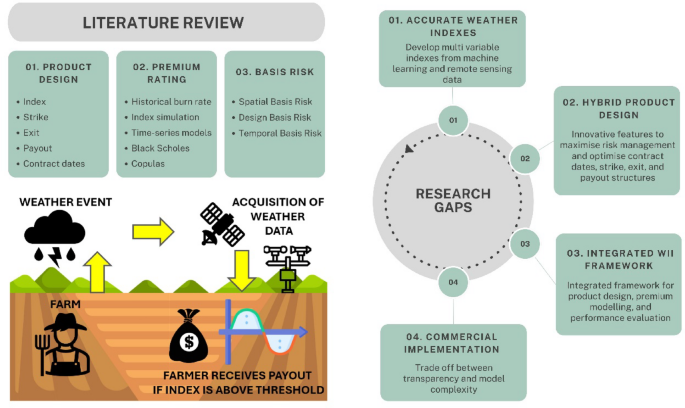
    Weather index insurance is a type of parametric insurance where payouts are triggered by specific weather parameters such as rainfall, temperature, or humidity levels. Instead of sending surveyors to assess crop damage, the insurance company uses verified weather data to determine if a payout should be made.

    For example, if a region experiences rainfall below a pre-defined threshold during the crop season, farmers automatically receive compensation. This eliminates lengthy claim processes and ensures faster relief for those affected.

    weather index insurance India

    How Does Weather Index Insurance Work in India?

    In weather index insurance in India, the process is straightforward and data-driven:

    1. Defining the Index: Insurers and agricultural experts identify weather parameters (e.g., rainfall or temperature) that significantly impact crop yield.
    2. Setting Triggers: Thresholds are established. For instance, rainfall below 50 mm in 15 days may trigger a payout.
    3. Collecting Data: Data is gathered from government-approved weather stations or satellite technology.
    4. Automatic Payouts: Once the weather data crosses the trigger point, the system automatically processes payouts to eligible farmers.

    This automated model reduces administrative costs and ensures transparency, helping farmers receive their claims quickly and fairly.

    Advantages of Weather Index Insurance

    1. Faster Claim Settlement

    Traditional crop insurance can take months to process claims. However, weather index insurance in India provides payouts within days, as it relies on objective data rather than field inspections.

    2. Reduced Disputes

    Because payouts are based on pre-agreed weather data, there is little room for disputes or fraudulent claims. Both insurers and farmers benefit from a transparent system.

    3. Cost-Effective for Farmers

    The absence of field surveys and manual assessments reduces operational costs for insurers, allowing them to offer lower premiums to farmers.

    4. Supports Small and Marginal Farmers

    Small farmers who may not have access to large financial resources can still benefit from affordable protection. This inclusivity is one reason why the Government of India promotes such schemes under initiatives like the Pradhan Mantri Fasal Bima Yojana (PMFBY).

    5. Encourages Technological Adoption

    Weather index insurance drives the use of digital tools like satellite imaging, automated weather stations, and AI analytics in rural India. This not only benefits insurance companies but also improves agricultural decision-making for farmers.

    Challenges of Weather Index Insurance in India

    Despite its potential, several challenges remain:

    • Data Gaps: Rural areas often lack accurate and localized weather data, leading to mismatched payouts.
    • Basis Risk: Sometimes, the recorded weather data doesn’t accurately reflect actual conditions on specific farms.
    • Awareness Issues: Many farmers are unaware of how weather index insurance in India works or how to enroll.
    • Infrastructure Limitations: Poor connectivity and lack of digital literacy make it difficult to implement high-tech insurance models effectively.

    Government Initiatives and Support

    The Indian government has been instrumental in promoting weather index insurance through various programs:

    • PMFBY (Pradhan Mantri Fasal Bima Yojana): Incorporates weather-based insurance modules to ensure quick payouts.
    • Weather-Based Crop Insurance Scheme (WBCIS): Introduced specifically to address weather-related risks using parametric triggers.
    • Digital India & Agritech Partnerships: Several private insurers are now partnering with weather data firms and government platforms to improve accuracy and coverage.

    These initiatives aim to ensure that farmers across India—especially in states like Maharashtra, Gujarat, and Karnataka—can access reliable insurance against weather-induced losses.

    weather index insurance India

    Technology’s Role in Weather Index Insurance

    Technology plays a central role in the success of weather index insurance in India:

    • Satellite Monitoring: Provides real-time information on rainfall and temperature trends.
    • IoT Devices: On-ground sensors monitor soil moisture, temperature, and humidity.
    • Blockchain: Ensures data transparency and reduces fraud.
    • Mobile Apps: Allow farmers to check policy status, claim updates, and weather alerts.

    By leveraging technology, insurers can ensure that payouts are quick, accurate, and trustworthy.

    Case Study: Impact on Rural India

    In Maharashtra, farmers enrolled in weather index insurance during drought seasons received automatic payouts within 10 days of rainfall deficiency being recorded. This timely assistance prevented them from falling into debt traps and allowed them to prepare for the next planting season. Similar results have been seen in parts of Gujarat and Rajasthan, where weather-linked insurance has become a critical part of rural financial resilience.

    How Farmers Can Enroll

    Farmers can apply for weather index insurance in India through:

    • Authorized banks and cooperative societies
    • Local insurance agents
    • Online platforms like KaroInsure
    • Government agricultural offices

    KaroInsure simplifies the enrollment process by offering easy policy comparisons, guidance, and digital claim support.

    Conclusion

    Weather index insurance in India is reshaping the future of rural risk management. By replacing manual surveys with automated data-driven processes, it offers transparency, affordability, and speed. As technology continues to evolve, more farmers will gain access to reliable insurance that helps them recover from weather shocks and sustain their livelihoods.

    For those looking to explore or enroll in weather index insurance, KaroInsure provides expert support and access to trusted insurance partners—empowering rural India with financial stability and resilience.

  • Livestock Insurance in India: Protecting Farmers Beyond Crops

    Livestock Insurance in India: Protecting Farmers Beyond Crops

    Agriculture in India goes beyond just crops — livestock plays an equally vital role in the rural economy. For millions of Indian farmers, animals such as cows, buffaloes, goats, and poultry are key assets that provide income, food, and security. Yet, these animals face risks from diseases, accidents, and natural disasters. This is where livestock insurance in India becomes essential.


    What Is Livestock Insurance?

    Livestock insurance is a policy designed to protect farmers against the financial loss that occurs if their insured animals die or become permanently disabled due to accidents, diseases, or natural calamities. In India, this coverage is particularly crucial for small and marginal farmers who depend heavily on their livestock for daily livelihood.


    livestock insurance India

    Importance of Livestock Insurance in India

    Livestock contributes significantly to India’s GDP through dairy, poultry, and meat industries. However, disease outbreaks, floods, and droughts can lead to devastating losses. Livestock insurance in India ensures that farmers receive compensation quickly, allowing them to recover and sustain their income.

    Some key benefits include:

    • Financial security: Farmers are compensated for losses, reducing economic hardship.
    • Stability in income: Even after animal loss, farmers can sustain themselves.
    • Encouragement for better animal care: Insured farmers are more likely to maintain health records and vaccinations.
    • Support for rural development: With financial protection, rural communities remain resilient during crises.

    Coverage Under Livestock Insurance in India

    Typical policies cover:

    • Death due to diseases or accidents
    • Permanent disability leading to loss of productivity
    • Natural calamities like floods, lightning, and landslides
    • Theft or injury (in certain plans)

    However, exclusions may include death due to negligence, war, or unregistered animals.


    Government Support for Livestock Insurance

    The Government of India, through the Department of Animal Husbandry and Dairying, provides subsidized insurance schemes for farmers. Some initiatives include:

    • Livestock Insurance Scheme (LIS): Offers up to 50% subsidy on premium for farmers.
    • Rashtriya Gokul Mission: Promotes genetic improvement and provides coverage for high-value indigenous cattle.
    • State-specific schemes: Many states like Maharashtra and Gujarat run their own livestock protection programs.

    These efforts aim to improve livestock management and financial inclusion among rural populations.


    livestock insurance India

    How to Apply for Livestock Insurance in India

    Farmers can purchase policies through:

    • Government veterinary offices
    • Authorized insurance agents
    • Agricultural cooperative societies
    • Online platforms like KaroInsure for simplified insurance comparison and quick policy issuance

    Steps:

    1. Register your livestock with proper identification (ear tag or microchip).
    2. Submit documents like ownership proof, vaccination certificate, and ID.
    3. Pay the premium (subsidy applied for eligible farmers).
    4. Claim in case of loss with a veterinary certificate and death report.

    Challenges in Livestock Insurance Adoption

    Despite its benefits, awareness about livestock insurance in India remains low. Common challenges include:

    • Limited access to insurers in rural areas
    • Delays in claim settlements
    • Lack of awareness about policy terms and eligibility

    However, with growing digital insurance platforms like KaroInsure, farmers now have easier access to transparent, quick, and paperless insurance options.


    Conclusion

    Livestock insurance is more than just a financial product — it’s a lifeline for millions of Indian farmers. It ensures protection beyond crops, helps maintain income stability, and supports rural resilience. As awareness and accessibility grow, livestock insurance in India will continue to play a vital role in securing the future of the country’s agricultural backbone.

  • Blockchain in Insurance: Revolutionizing Trust and Transparency

    Blockchain in Insurance: Revolutionizing Trust and Transparency

    The insurance industry in India has always faced challenges related to data security, claim delays, and lack of transparency. With blockchain in insurance in India, these issues are being addressed through advanced, secure, and transparent systems that are transforming how insurers and policyholders interact.


    What Is Blockchain in Insurance?

    Blockchain is a decentralized digital ledger that records transactions across multiple computers securely and transparently. In the insurance sector, this means that every policy, claim, and payment can be verified and tracked without manual intervention — reducing errors and fraud.


    blockchain in insurance India

    How Blockchain Is Transforming the Indian Insurance Sector

    1. Enhanced Transparency

    With blockchain, all transactions are stored on a shared, immutable ledger. This means both insurers and policyholders can verify details in real time, ensuring greater trust and eliminating disputes.

    2. Faster Claims Processing

    Claims can be automated using smart contracts, which execute predefined actions when certain conditions are met. For instance, in motor insurance, a claim could automatically trigger when an accident report is filed and verified digitally.

    3. Reduced Fraud

    Insurance fraud is a major concern in India. Blockchain prevents tampering of data and ensures that every claim is verified through a transparent, secure network — reducing fraudulent claims significantly.

    4. Improved Data Security

    Blockchain uses encryption and distributed storage, making it nearly impossible for hackers to alter or steal sensitive customer data. This ensures better data protection and compliance with IRDAI regulations.

    5. Simplified Reinsurance and Policy Management

    Blockchain allows seamless data exchange between insurers and reinsurers, reducing manual paperwork and ensuring accurate, up-to-date policy information.


    Blockchain Applications in Indian Insurance

    • Health Insurance: Streamlining hospital records, medical histories, and claim settlements.
    • Motor Insurance: Automated claim validation through IoT and blockchain integration.
    • Crop Insurance: Tracking weather data and claim triggers for parametric insurance.
    • Life Insurance: Securing policyholder information and automating payouts.

    blockchain in insurance India

    Challenges in Adopting Blockchain in India

    • Lack of awareness and technical expertise.
    • Regulatory and data privacy hurdles.
    • High initial implementation costs for insurers.

    However, with government initiatives supporting digital transformation and IRDAI’s push for innovation, blockchain adoption is gradually increasing.


    The Future of Blockchain in Indian Insurance

    Blockchain technology has the potential to make insurance more customer-centric, efficient, and secure. As digital adoption rises, blockchain in insurance in India will play a crucial role in establishing trust and transparency in every transaction.


    Conclusion

    Blockchain is redefining how insurance works in India — making it smarter, faster, and more transparent. As more companies and regulators embrace this technology, policyholders can look forward to a future of hassle-free and trustworthy insurance experiences.

  • Parametric Crop Insurance in India: Farmers, Weather Triggers & Faster Payouts

    Parametric Crop Insurance in India: Farmers, Weather Triggers & Faster Payouts

    Agriculture is the backbone of India’s economy, but it’s also one of the most vulnerable sectors to weather risks. Traditional crop insurance schemes often take months to process claims, leaving farmers waiting for critical financial support. This is where Parametric Crop Insurance in India comes in — offering faster, transparent, and data-driven payouts.

    What Is Parametric Crop Insurance?

    Parametric crop insurance is a modern insurance model that pays out based on pre-defined parameters such as rainfall, temperature, or wind speed — rather than the actual loss assessment on the ground.
    For example, if rainfall drops below a certain level or exceeds it beyond a threshold, the insurance automatically triggers a payout to farmers.

    This model removes the lengthy claim verification process and provides quick relief when farmers need it most.

    parametric crop insurance India

    How It Works

    1. Parameter Setup: The insurer sets measurable weather triggers (like rainfall or temperature) using reliable data sources such as IMD (India Meteorological Department).
    2. Monitoring: Weather data is continuously monitored through satellites and local weather stations.
    3. Trigger Event: When the weather deviates from the agreed threshold — say, less than 70 mm of rain in 20 days — the policy is triggered.
    4. Instant Payouts: The insured farmer receives an automatic payout without needing to file a claim or wait for a field inspection.

    Why Parametric Crop Insurance Matters in India

    India’s farmers face unpredictable climate patterns, including droughts, floods, and cyclones. With parametric insurance:

    • Payouts are faster, often within days instead of months.
    • Transparency is higher because data drives every decision.
    • It helps reduce dependence on government compensation programs.
    • Farmers can plan better and recover quickly from natural shocks.

    Benefits of Parametric Crop Insurance

    • Speed: Immediate payouts reduce financial stress after a disaster.
    • Simplicity: No need for field loss verification.
    • Fairness: Eliminates disputes since payouts are data-based.
    • Scalability: Can cover small, marginal, and large farmers efficiently.
    • Support for Climate Resilience: Encourages adoption of climate-smart agriculture.
    parametric crop insurance India

    Challenges in Implementation

    While the model sounds ideal, Parametric Crop Insurance in India faces a few challenges:

    • Data Gaps: Inconsistent weather data in rural regions can affect accuracy.
    • Awareness: Farmers need more education about how parametric insurance works.
    • Premium Costs: Advanced technology use can increase the initial cost.
    • Customization: Weather conditions vary across regions, requiring localized plans.

    Government and Private Initiatives

    The Government of India, along with insurers like AIC (Agriculture Insurance Company) and IRDAI-approved private firms, has started pilot projects in states like Maharashtra and Andhra Pradesh.
    Insurance brokers like KaroInsure help connect farmers and agribusinesses to trusted insurers offering parametric insurance models tailored to Indian conditions.

    How KaroInsure Supports Parametric Crop Insurance

    KaroInsure works with multiple insurers across India to offer innovative agricultural insurance solutions, including:

    • Customized weather-trigger policies for farmers and agri-companies.
    • Fast digital claim processing and payout monitoring.
    • Expert guidance on choosing the right coverage for your region and crops.

    By simplifying complex insurance concepts, KaroInsure ensures that Indian farmers benefit from technology-backed, timely protection.

    Conclusion

    As climate risks rise, Parametric Crop Insurance in India represents the future of agricultural protection. Its data-driven design ensures transparency, efficiency, and speed — three things that farmers have long needed.
    With platforms like KaroInsure, Indian farmers can now access modern insurance solutions that truly understand the challenges of today’s agriculture.

  • Green & Sustainable Lifestyles: Insurance Solutions for Eco-Conscious Consumers

    Green & Sustainable Lifestyles: Insurance Solutions for Eco-Conscious Consumers

    As more people embrace sustainability in their everyday lives, financial decisions are also becoming greener. Green Lifestyle Insurance is one such initiative that allows eco-conscious consumers to protect what matters most — their health, home, and planet — in an environmentally responsible way. In India, insurers and digital platforms like KaroInsure are increasingly offering products that reward sustainable choices.


    Green Lifestyle Insurance – Eco-Friendly Coverage

    What Is Green Lifestyle Insurance?

    Green Lifestyle Insurance refers to insurance products designed to promote eco-friendly behavior. These plans may include premium discounts for using electric vehicles, installing solar energy systems, or maintaining an energy-efficient home.
    In addition, some insurers invest in green bonds or sustainable projects, ensuring your money supports a cleaner future.


    Why Sustainability Matters in Insurance

    Climate change and environmental degradation are increasing the number of natural disasters, affecting homes, vehicles, and health. As a result, insurers are now focusing on policies that reduce carbon footprints and encourage responsible consumption.

    Moreover, customers who follow sustainable lifestyles — such as using renewable energy or supporting eco-friendly products — are now being recognized through lower premiums and additional benefits.


    Types of Green Insurance Policies Available in India

    1. Green Home Insurance

    Green home insurance protects energy-efficient homes and covers sustainable materials used in construction.
    For instance, if your eco-friendly home with solar panels is damaged, the insurance covers green rebuilding costs.

    2. Electric Vehicle (EV) Insurance

    EV owners can now access special motor insurance policies that include coverage for charging equipment and battery replacement. Since EVs produce zero emissions, some insurers even offer lower premiums as an incentive.

    3. Health Insurance for Eco-Conscious Individuals

    Some insurers are now integrating wellness rewards into health insurance plans. For example, walking, cycling, or maintaining a plant-based diet can earn you premium discounts or reward points that can be used for health checkups.

    4. Travel Insurance for Sustainable Tourism

    Eco-friendly travel insurance is designed for travelers who prefer sustainable tourism. It may cover green accommodations or carbon-offset options, ensuring your travel plans are both secure and responsible.


    Green Lifestyle Insurance – Eco-Friendly Coverage

    Benefits of Green Lifestyle Insurance

    Choosing sustainable insurance options provides benefits that go beyond financial protection:

    • Lower Premiums for Sustainable Living:
      Insurers often offer incentives or discounts for using renewable energy or low-emission vehicles.
    • Contribution to Environmental Goals:
      Your policy may directly or indirectly fund green initiatives, renewable energy, or tree plantation programs.
    • Long-Term Cost Savings:
      By investing in green solutions, you not only save on energy bills but also secure insurance benefits.
    • Positive Social Impact:
      Supporting insurers who prioritize sustainability encourages others to make eco-friendly financial choices.

    How Insurers Are Encouraging Sustainable Choices

    Leading insurance companies in India are incorporating sustainability into their operations. Some are digitizing their entire process — from paperless onboarding to e-policy issuance — drastically reducing paper waste.

    Furthermore, companies like KaroInsure promote digital insurance solutions that are not only fast and convenient but also environmentally friendly. This digital shift ensures customers can buy, compare, and renew policies without paperwork — aligning with sustainable practices.


    Challenges in Adopting Green Insurance

    While the benefits are clear, awareness about green insurance remains limited in India. Many consumers still choose traditional insurance plans without realizing they can support eco-friendly initiatives through their policies.

    Additionally, insurers need to design affordable and transparent green products that appeal to the broader public. Educating consumers about how these policies work is equally important to promote adoption.


    Green Lifestyle Insurance – Eco-Friendly Coverage

    Future of Green Lifestyle Insurance in India

    The future of Green Lifestyle Insurance in India looks promising. With rapid urbanization and rising environmental awareness, more individuals and businesses are seeking ways to align their financial choices with sustainability.

    Moreover, government incentives for electric vehicles, renewable energy, and smart cities are pushing the insurance sector to innovate faster. In the next few years, we can expect a surge in products that combine technology, sustainability, and protection — redefining how Indians view insurance.


    Conclusion

    The shift toward Green Lifestyle Insurance reflects a powerful trend — consumers are no longer satisfied with just protection; they also want purpose. By choosing eco-friendly insurance policies, you are not only safeguarding your assets but also contributing to a sustainable planet.

    At KaroInsure, we believe that small steps like going paperless or choosing a green plan can create a big impact. Explore our range of sustainable insurance options and be a part of India’s greener tomorrow.